- Home >
- Philip's Corner >
- Computing >
- 803 Mods
To improve the usability of the 803, several additions were made to the system over the years.
Teleprinter direct keyboard entry
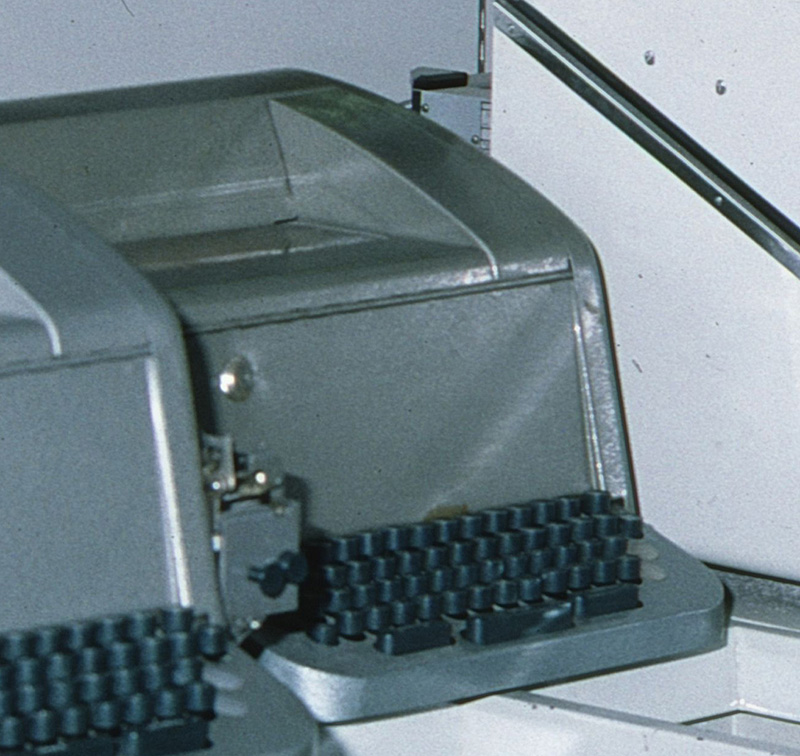
The first new piece of equipment to be added was an additional Creed 75 teleprinter. This had no tape punch, but importantly did have a keyboard transmitter. Connecting that transmitter to the 803 would enable us to type in responses directly to the computer, avoiding the need to punch them onto paper tape.
Attaching it as a second printer was straightforward as the paper tape station already had the electronics to support it, but the 803 had no facility for direct keyboard input.
There were a few free slots in the card rack at the back of the paper tape station, so they were filled with new hardware to convert the serial keyboard output into what the 803 thought was data coming from a second tape reader.
One snag is that a tape reader will stop when the computer is not ready for another character. However it can't stop the operator bashing away on the keyboard, and the typed data getting lost. So the new hardware had to have an input buffer to capture data from over enthusiastic typing until the computer caught up.
All of this was built with 7400 series logic, and plenty of discrete components handling voltage level shifting between TTL levels and those used by the paper tape station.
That was my first real project using TTL devices, but sadly, no documentation or photos of that contraption has survived the passing years.
----------
Speeding up Algol compiler loading
The Algol 60 compiler was the most often used software on the 803. It frequently needed to be loaded from its two large reels of paper tape, and that wasted a lot of time even though the amount of data actually loaded was only equivalent to about 30kb.
Some Elliott 803 installations had 'film drives' to speed up loading and storing of data, but unfortunately our system did not have them.
We were lucky enough to acquire an old IBM 1620 computer with a 2Mb disk drive, and as our 803 had some bits of the logic required for direct memory I/O (as needed by the film drives), it was possible to tap into that and connect the 803 to the processor of the 1620.
After an installed memory image of the 803 Algol had been transferred to the 1620's hard disk, installing the compiler on the 803 then consisted of just '40 0' loading a short 'trigger' paper tape about 2 metres long. That initiated the transfer of the compiler from the IBM's hard disk directly into the 803's memory, and that took just a few seconds.
----------
Visual Display Terminal
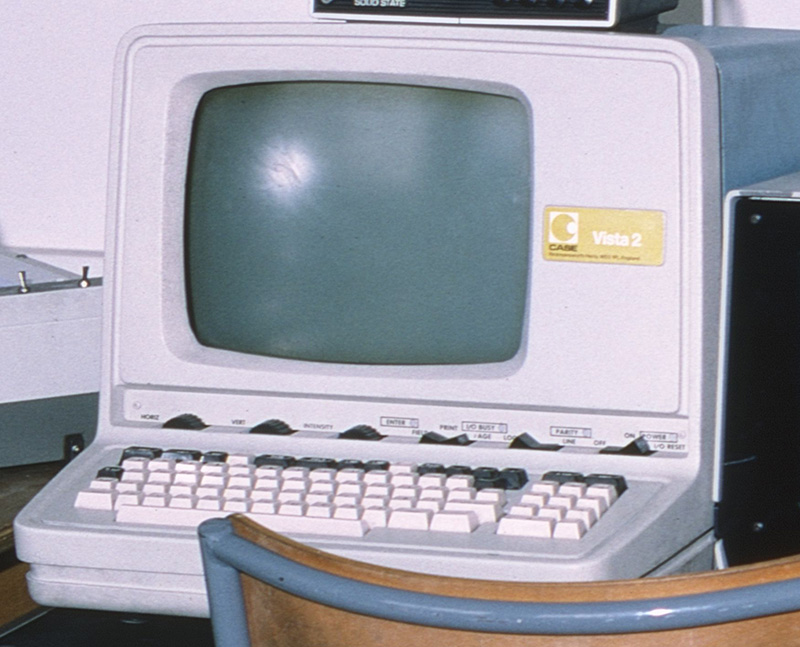
After connecting this "Case Vista 2" terminal to the 803, it became possible to create and run much more interactive applications on the 803.
One strange thing about this terminal was that keyboard data was not sent immediately, but was formatted as a message block, and then only sent after pressing a 'Transmit' key. This completely ruined any attempt for interactivity
The terminal's hardware was hacked and the keyboard disconnected from the internal logic, its data then becoming accessible one keypress at a time.
----------
Graphic DIsplay
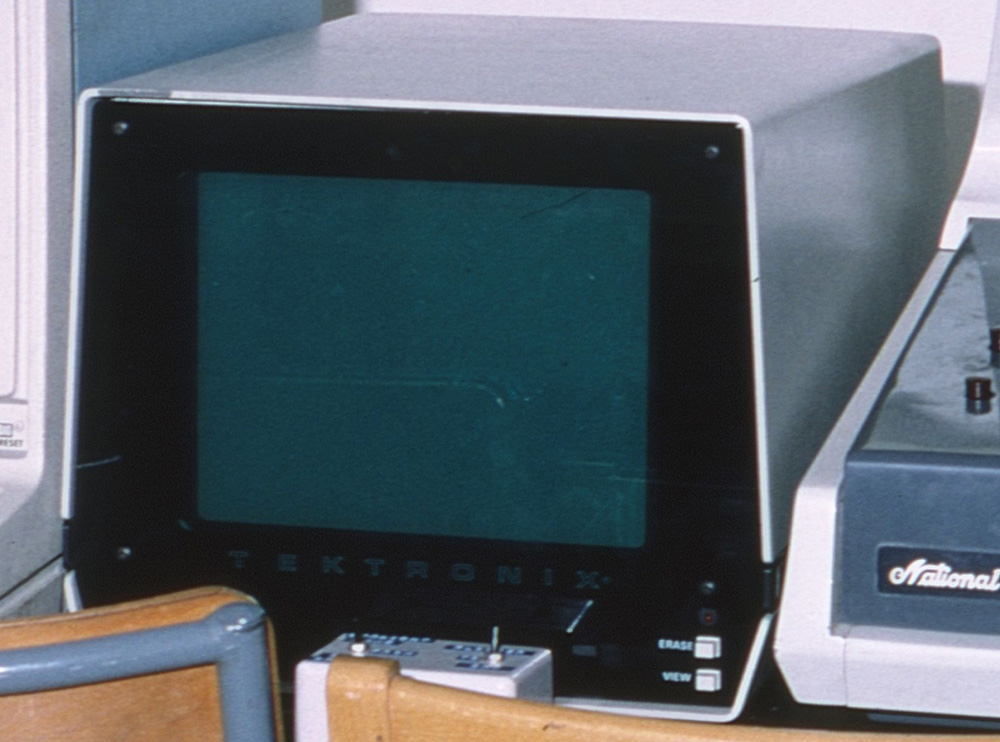
This Tektronix 613 storage display was also connected, and we could then create graphics from the 803.
The 613 was very simple to drive, requiring analogue X/Y input plus beam on-off (Z axis) control and another signal to erase the screen.
The analogue drives to the display came from D/A converters, but these were not driven directly by the 803, but by a DDA (Digital Differential Analyser), one for each of the X and Y axis. The 803 drove the DDA's and gave the ability to plot complex curves.
The hardware involved in driving the 613 was also used for controlling an X/Y plotter for paper hard copy.